
A custom bag manufacturer resolves the product decisions that remain between the buyer’s current input and a repeatable manufactured product. Those decisions may concern appearance, structure, materials, hardware, or production method. The useful starting question is: What remains unresolved between the buyer’s current input and a production-ready product?
Appearance changes can alter how the bag is built
Dimensions, proportions, color, finish, and branding are visible customization choices, but they are not always surface-level changes. Widening a bag can alter panel proportions, pocket positions, zipper length, and the way the base supports the body. Moving a brand element may place it over a seam, reinforcement, pocket, or curved area where the original construction no longer works.
Even a proportion change can affect pattern balance. A taller soft bag may collapse differently; a narrower opening may restrict access or change the order in which lining and closure components are assembled. Appearance should therefore be reviewed on the physical construction, not only on a drawing.
Structural customization changes connected parts
Openings, pockets, internal organization, carry methods, and handle or strap attachments define how the bag works. Changing one feature can shift loads or remove space needed by another.
For example, adding an internal pocket behind a handle attachment may create a thicker seam stack exactly where reinforcement and clean stitching are required. Moving the pocket may protect the attachment construction but change usability. The correct decision depends on which function has priority and how the layers can be assembled.
A longer strap is not merely more material either. The attachment area must suit the intended carry method and the load path through the bag body. Reinforcement that improves support may also make a turned edge too bulky, requiring a change in reinforcement extent, skiving, or edge construction.
Materials and hardware must match the construction
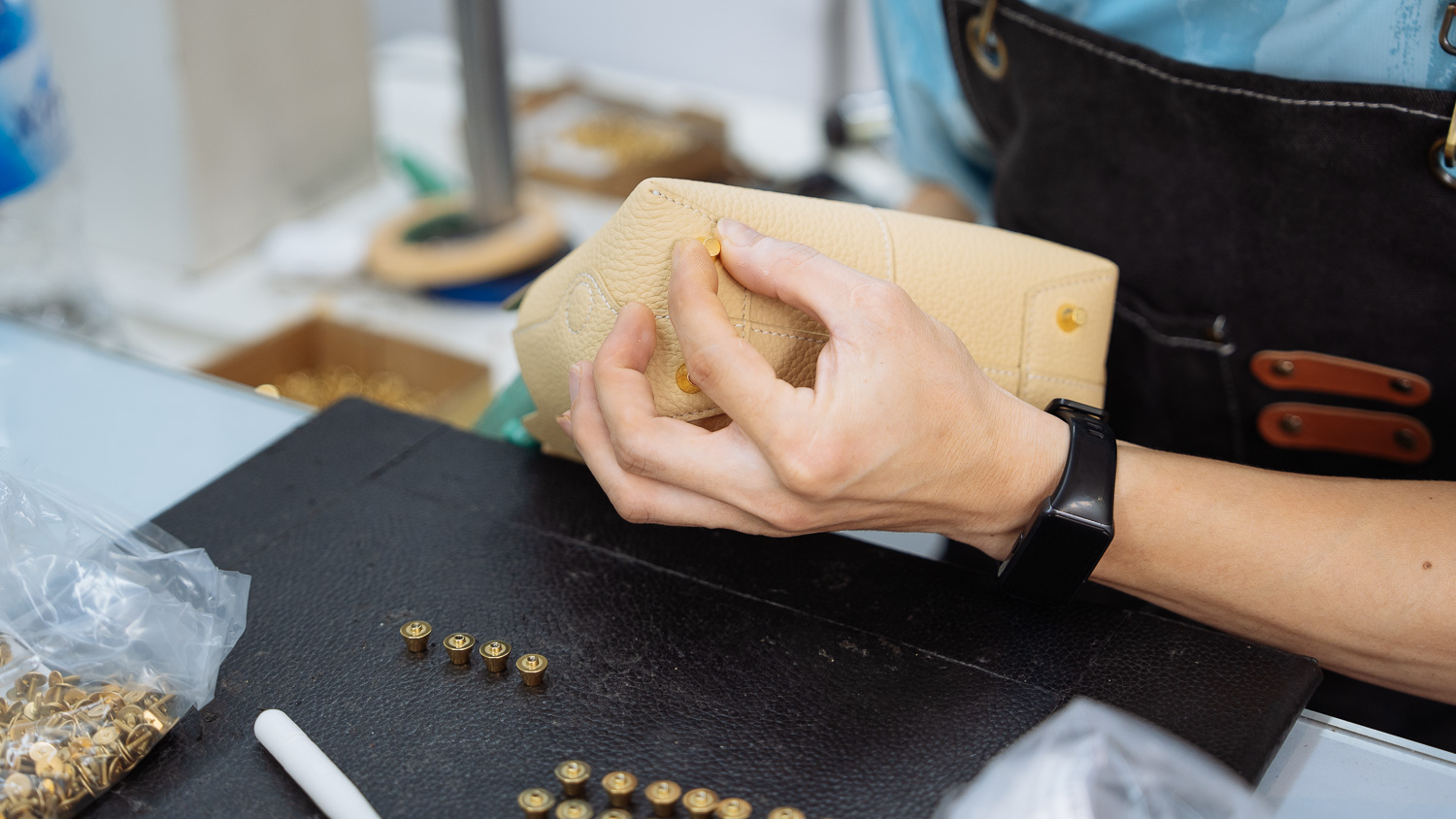
A material choice affects more than appearance. Thickness and firmness influence folding, seam allowance, edge finishing, turning, and how the bag holds its shape. Substituting a thicker exterior while keeping the same pattern and skiving logic can produce bulky corners or an uneven edge.
Hardware also acts on the product around it. A heavier closure or fitting may change the drape of a soft panel and increase stress at its attachment. A custom hardware shape may require different clearances, backing, attachment logic, or assembly access. Material and component decisions should therefore be tested as a system rather than approved from separate swatches and drawings.
HONG STUDIO supports material, hardware, feasibility, and structural development within its broader Research & Development capability.
A complete-looking design may still need engineering
A tech pack can clearly define dimensions, colors, specified materials, hardware, and visible details while still leaving production questions open. This does not mean every tech pack is incomplete. It means completeness must be judged against the actual bag and its construction.
Typical unresolved points include where reinforcement begins and ends, how layers are skived, which seam or edge construction is intended, how hardware is backed and attached, and in what sequence enclosed components can be assembled. A dimension may also need an agreed production reference if material behavior or construction makes the finished result sensitive to interpretation.
The manufacturer’s job is to identify these gaps without changing the design casually. A prototype or development sample makes the consequences visible: the brand can then confirm which appearance and functional decisions are intentional and which need refinement.
Production readiness means the open decisions are closed
Before bulk production, the approved product, materials, hardware, structure, color, construction, and relevant process requirements should describe the same production intent. A Pre-Production Sample (PPS) is useful because it brings those finalized decisions together in a physical reference; it is not a substitute for the supporting production information.
HONG STUDIO connects design, materials, engineering, prototyping, validation, and owned production according to the work a project still requires. Its Project Pathways explain how different starting inputs are routed, while the Production page covers the manufacturing stage.
For an initial review, send the strongest current input and identify what is fixed, what may change, and what remains uncertain. That is more useful than labeling the project simply “custom.”